Applications are now open for designation as a Congenital Hyperinsulinism International (CHI) Tier 1 Center of Excellence (COE) and Tier 2 HI Center.
CHI offers two designations to recognize centers providing specialized care for people with congenital hyperinsulinism (HI). Both designations support CHI’s mission to improve access to high-quality HI care worldwide. Each designation recognizes an important role in the broader HI care network, and the information below can help you determine which application is the best fit for your center.
Tier 1 Center of Excellence (COE)
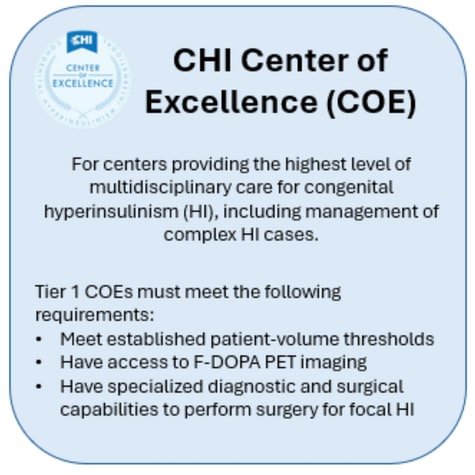
The Tier 1 Center of Excellence (COE) designation, which launched in 2020, recognizes centers that provide the highest level of multidisciplinary HI care, with the patient volume, expertise, and specialized diagnostic and surgical capabilities needed to manage complex cases. Consider the Tier 1 application if your center has seen 50 patients in the last year and 100 patients since the center was founded, has F-DOPA PET imaging capabilities, and has the expertise to perform surgery for focal HI. The COE designation will be upheld through 2029.
Learn more about the Tier 1 CHI COE program, including the rest of the application criteria.
Applications for the Tier 1 CHI COE program are due January 17, 2027!
Tier 2 HI Center
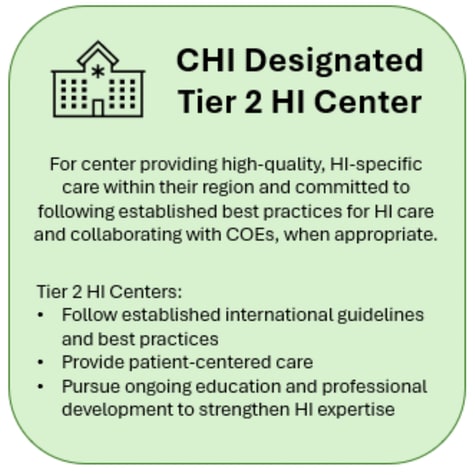
The newly created Tier 2 HI Center designation recognizes centers providing high-quality HI care within their healthcare systems and geographic regions. These centers play an important role in expanding access to knowledgeable, coordinated care closer to home while strengthening clinical experience and maintaining pathways to Tier 1 COE consultation or referral when needed. Consider the Tier 2 application if your center provides HI-specific patient-centered care and follows established international guidelines and best practices, but does not currently meet the patient volume, imaging capabilities, or multidisciplinary team experience required for Tier 1 COE designation. Tier 2 centers are committed to advancing HI clinical knowledge and expertise through ongoing education, professional development, and collaboration with COEs. The Tier 2 HI Center designation will be upheld through 2029.
Learn more about the Tier 2 HI Center designation.
Applications for the Tier 2 HI Center designation are due January 17, 2027!
If viewing on a mobile device, click here to see the chart presented below.
For more information about the expectations of Tier 1 and Tier 2 centers, see the chart below:
CHI Designated Tier 1 HI Center of Excellence (COE)
CHI Designated Tier 2 HI Center
A Center of Excellence represents the highest level of HI care, with advanced HI expertise, a fully integrated multidisciplinary model, and the infrastructure to manage the full spectrum of HI, including complex diagnostic, genetic, surgical, transitional, and long-term care needs. COEs demonstrate substantial clinical experience, serve as national and international referral leaders, align care with recognized clinical guidelines, contribute to research and education, and support patients, families, and other clinicians through coordinated, evidence-based, family-centered care.
A Tier 2 HI Center provides high-quality, guideline-informed HI care through established clinical expertise, coordinated multidisciplinary collaboration, and access to key diagnostic, genetic, surgical, transition, and support services within the center’s available resources. Tier 2 centers serve as important regional or national access points for HI care, manage patients whose needs are within their scope of services, remain current with evolving standards, engage in research or quality improvement when feasible, and collaborate with or refer to Centers of Excellence for highly complex cases or services requiring advanced COE-level expertise.
Health System Affiliation and Multidisciplinary Support
The center is affiliated with a pediatric health system that provides a broad range of specialty services relevant to the care of individuals with HI, including, but not limited to, cardiology, neurology, gastroenterology, and genetics. Specialists from these disciplines actively collaborate with the center as part of a coordinated, multidisciplinary approach to HI care.
The center is affiliated with a pediatric health system that provides access to established specialty services relevant to the care of individuals with HI. The center has the institutional infrastructure necessary to support multidisciplinary evaluation and management when needed.
Clinical Reach and Referral Leadership
Demonstrates a sustained, high-volume clinical practice serving a substantial population of patients with HI, with an expected volume of 50 or more patients annually and at least 100 patients seen since the center’s founding. Tier 1 COEs are recognized as both a national and international referral center. The center serves as a leader, providing specialized expertise and attracting patients from a broad catchment area.
Provides care to an established population of patients with HI, generally and serves as a recognized resource with demonstrated HI clinical experience and referral activity.
The center includes multiple HI specialists with extensive experience managing a broad range of HI presentations and a demonstrated record of leadership in clinical care, education, and research.
The center includes at least one HI specialist with established experience in the diagnosis and management of HI and a commitment to maintaining expertise in current standards of care.
Multidisciplinary Care Model
The center provides a formal, fully integrated multidisciplinary model of care for individuals with HI. Multidisciplinary collaboration is embedded within care delivery and includes regular coordination among relevant specialists, reflecting the center’s role as a leader in comprehensive HI care.
The center provides coordinated multidisciplinary care appropriate to the complexity of HI. While a formal multidisciplinary program may not be in place, established processes ensure timely collaboration among relevant specialties to support comprehensive patient care.
HI Care Coordination and Clinical Oversight
The center has a defined HI clinical management model in which all individuals with HI are evaluated, managed, or directly overseen by an HI specialist. Treatment decisions and care plans are developed through a structured process that incorporates multidisciplinary input when appropriate and ensures consistent application of HI expertise across the continuum of care.
The center has established processes to ensure that individuals with HI receive care informed by HI-specific expertise. HI specialists are involved in the evaluation, management, or consultation of patients as appropriate, and individualized care plans are developed using a coordinated approach to care.
Evidence-Based Diagnostic and Clinical Care
Centers of Excellence demonstrate advanced expertise in the diagnosis and clinical management of hyperinsulinism and provide care that is consistently aligned with internationally recognized clinical practice guidelines. The center has established protocols for the evaluation of hypoglycemia, confirmation of HI diagnoses, and ongoing management of patients across the spectrum of disease severity. Clinical decision-making reflects current evidence and best practices, with regular review and integration of evolving guideline recommendations.
Centers demonstrate experience in the diagnosis and clinical management of hyperinsulinism and follow evidence-based approaches consistently with recognized clinical practice guidelines. The center utilizes established diagnostic and treatment pathways for patients with suspected or confirmed HI and incorporates guideline recommendations into routine clinical care. Providers maintain awareness of current standards and seek specialty consultation or referral as appropriate for complex cases.
Genetic Testing, Interpretation, and Counseling
The center has established processes to ensure timely access to genetic testing and counseling for all patients with suspected or confirmed HI, except those likely to have an acquired form of HI. Rapid genetic testing is available on-site or through established arrangements and parental testing is conducted, when appropriate, consistent with current clinical recommendations. Genetic test results are reviewed and interpreted by clinicians with expertise in HI and are incorporated into diagnostic assessment, treatment planning, prognosis, and family counseling. The center demonstrates the ability to manage and counsel patients across a broad range of genetic etiologies and complex genetic findings, including inconclusive findings, and determining when additional genetic evaluation may be warranted.
The center recognizes the important role of genetic evaluation in the diagnosis and management of HI. Providers understand the clinical implications of common HI-related genetic findings and incorporate available genetic information into patient care and treatment decisions. Rapid genetic testing and genetic counseling are available either on-site or through established arrangements and is provided for all children (and parents if the child’s results are positive), except those likely to have an acquired form of hyperinsulinism.
Centers of Excellence provide comprehensive surgical care for patients with HI and possess the multidisciplinary expertise required to evaluate, plan, perform, and manage pancreatectomies. The center has access to specialized surgical, pathology, radiology, and endocrinology expertise and demonstrates experience in both focal and diffuse forms of HI. Surgical decision-making is integrated with preoperative diagnostic evaluation, including imaging and genetic findings when appropriate, and involves close collaboration among specialists before, during, and after surgery. The center has established processes for postoperative management and long-term follow-up.
Tier 2 Centers are equipped to evaluate patients with HI for surgical intervention and to provide perioperative management for appropriately selected cases. The center demonstrates access to relevant surgical, radiologic, and pathology expertise and maintains processes for coordination of care with HI specialists. Specialty Centers recognize the benefits of referral to a Center of Excellence for complex surgical evaluation and treatment, particularly when advanced radiology, specialized pathology support, or extensive HI surgical experience are necessary to achieve optimal outcomes.
Care Continuity, Transitions, and Support
Centers of Excellence provide coordinated, longitudinal care that supports patients and families across all care settings and stages of life. The center has established processes to facilitate safe and effective transitions between inpatient and outpatient care, across healthcare facilities, and from pediatric to adult services when appropriate. Patients and caregivers receive comprehensive education, care plans, and ongoing support for home management. The center monitors clinical outcomes and care transition metrics to identify opportunities for quality improvement and to ensure continuity of high-quality care.
Tier 2 Centers demonstrate processes to support continuity of care for patients with hyperinsulinism across clinical settings. The center provides discharge planning, patient and caregiver education, and support for home management, while coordinating care with community providers and other specialists as needed. The center facilitates transitions between facilities and supports patient transfers to adult care when appropriate. Care teams monitor patient outcomes and use established follow-up processes to promote ongoing engagement and safe transitions.
Centers of Excellence demonstrate a strong commitment to advancing the understanding and treatment of hyperinsulinism through research, innovation, and knowledge sharing. The center actively participates in or leads clinical, translational, and/or basic science research and contributes to the development of evidence that improves patient outcomes. Patients and families are informed about relevant research opportunities when appropriate, and clinicians contribute to the advancement of the field through publications, presentations, guideline development, registries, collaborative networks, or other scholarly activities.
Tier 2 Centers support the advancement of hyperinsulinism care through engagement with research and evidence-based practice. The center remains current with emerging scientific developments and may participate in clinical research studies, patient registries, quality improvement initiatives, or collaborative research networks. Providers incorporate new evidence into clinical care and facilitate patient participation in research opportunities when available, either directly through the center or through collaboration with external research partners.
For any questions or to discuss application details further, please contact CHI’s Chief Research Officer, Tai Pasquini (tpasquini@congenitalhi.org)